

Is Guatemala Safe for Families? A Guide to Family Travel Safety in Guatemala.
If you are considering bringing your family to Guatemala, there is a pretty good chance that safety is one of the first questions you have. It is also one of the first questions people ask us.
And I understand why!
Search Guatemala online, and you will find plenty of stories about crime, travel warnings, dangerous neighborhoods, armed robbery, gangs and all the other things that make a parent wonder whether they have completely lost their mind for considering bringing their children here.
We have lived in Guatemala as a family for years. We have five children, and we didn’t come here because we thought Guatemala was some kind of tropical Disney World where nothing bad ever happens. We came because we found something here that was becoming increasingly difficult to find at home: freedom, community, relationships with people who actually know each other, and a way of life that allows our children to participate in the world around them rather than simply being transported between school, sports, organized activities and the family car.

So, is Guatemala safe for families?
The honest answer is that Guatemala is not uniformly safe, and it is not uniformly dangerous either. Like almost every country, there are places you should avoid, situations you should use common sense around, and things you should know before you arrive. There are also enormous parts of Guatemala where families travel, live, work and go about ordinary life every day without incident.
A quick overview of Guatemala
Guatemala is a country of more than 100,000 square kilometres with dramatically different regions, landscapes, cities and communities. Guatemala City is not Lake Atitlán. Lake Atitlán is not Antigua. Antigua is not Flores. Flores is not the Petén jungle. A small community in the highlands can feel worlds away from a neighborhood in Guatemala City, and the security situation in one part of the country does not automatically tell you what life is like somewhere else.
This is one of the things we find frustrating about the way government travel advisories are sometimes interpreted. A government may quite reasonably warn its citizens about a particular region, city or neighborhood, but the headline that appears on a travel advisory can make it sound as though the entire country is experiencing the same problem. That would be a little like deciding not to take your children to Colorado because there had been a shooting in Miami. The incident would be real, the warning would be worth taking seriously, and you would still be making a fairly strange geographical assumption.
The current U.S. travel advisory is actually more specific than the headline level can make it seem. It identifies particular areas, including Zone 18 in Guatemala City and Villa Nueva, as places where travelers should not go, while separately providing guidance for the rest of the country. (Travel.state.gov) That distinction matters.
There are places in Guatemala we would not take our children. There are also places where we feel completely comfortable letting them run around with their friends.
Knowing the difference is the important part.
Arriving in Guatemala City
For families coming to one of our Culture Chalk hubs, we recommend taking some of the uncertainty out of the first part of your trip.

We can arrange transportation with known, reliable and trusted drivers to meet you at the airport and take you directly to your hotel or onward destination. We don’t recommend arriving in Guatemala City, collecting your luggage and then figuring out transportation on the curb with five tired children and a jet-lagged parent who has no idea which direction the hotel is.
Guatemala City is divided into zones, and the areas where most international visitors stay are concentrated in a handful of neighborhoods. Zones 10, 13 and 14 are among the areas most commonly recommended for visitors, while Zone 13 has the particular advantage of being close to La Aurora International Airport. Zone 10, where many international hotels, restaurants and businesses are located, is another practical choice.
For most families, we recommend spending one night in Guatemala City before heading to your Culture Chalk hub.
If you arrive late at night, our preference is to keep things simple. Get picked up, drive a few minutes to a clean and comfortable hotel close to the airport, get some sleep and start the adventure in the morning.
We particularly like In & Out Hotel in Zone 13 for this kind of arrival. It is very close to La Aurora Airport, offers family rooms and has an airport shuttle.
Another good option is La Inmaculada Hotel, a small boutique hotel in Zone 10. It is a little farther from the airport but puts you in one of the city’s more established visitor areas.
If you arrive around midday the day before your hub begins, we like giving families a little more time to settle in. In that case, the Hyatt Centric Guatemala City in Zone 10 is a comfortable option, as is Deca Futura. These give you a chance to have a meal, walk around a little, swim, sleep properly and arrive at the hub the next day feeling like actual human beings again.
If you are arriving two days before your hub, we often recommend having one of our trusted drivers pick you up and taking you directly to Antigua for a couple of nights.
Antigua
Antigua is a fantastic place to begin a trip to Guatemala.

It is beautiful, walkable, full of restaurants, cafés, markets, churches, ruins, courtyards and cobblestone streets, and it has enough to keep a family busy without requiring a military-style itinerary.
Antigua Guatemala is also a UNESCO World Heritage Site, recognized for its preserved colonial architecture, historic street grid and remarkable collection of churches, monasteries and other buildings dating largely from the 17th and 18th centuries.
There is plenty to do in Antigua, and we have put together more detailed suggestions in our Guatemala Guide. If your family has a couple of extra days before heading to Lake Atitlán, Antigua is an excellent way to ease into Guatemala.
It also gives you a chance to discover something important about the country: Guatemala is not one experience.
The Guatemala that you encounter in Antigua is different from the Guatemala you will experience in San Pedro La Laguna. The experience of walking through a colonial city is different from sitting on a boat crossing Lake Atitlán. That difference is part of what makes traveling here so interesting.
The biggest safety concern we’ve experienced? Traffic.
For all the conversations about crime and violence, the biggest everyday safety concern we have experienced with our children in Guatemala has been traffic.
Seriously.
Guatemalan traffic operates at a different rhythm than what many North American families are accustomed to. Drivers are generally courteous, and pedestrians are everywhere, but the assumption that a painted crosswalk automatically means traffic will stop for you is one I would leave at the airport.
Keep your head up.

Make sure your children understand that crossing the road in Guatemala is not necessarily the same experience as crossing a road in Canada or the United States. Look both ways. Look again. Pay attention to motorcycles, tuk-tuks, buses, trucks and cars coming from directions you weren’t expecting.
And remember that a driver seeing you does not necessarily mean the driver intends to stop.
We would rather have our children be slightly paranoid around traffic than slightly optimistic.
Lake Atitlán with children
This is where our own experience becomes very different from what many families expect when they first look at Guatemala on a map.
We have found Lake Atitlán to be an extraordinary place for children.

Our own children have built friendships and relationships with boat drivers, tuk-tuk drivers, shop owners, families and people in communities all around the lake. Those relationships have changed the way we think about what children are capable of doing independently.
Our older children, who speak Spanish and have a strong sense of direction, have reached the point where we are comfortable with them getting in a boat and going to visit friends or explore another town without us.
That is not something we would recommend for every child who arrives in Guatemala.
It works for our children because they speak Spanish, they know the area, they have a good sense of direction, they are comfortable talking to strangers when they need help, and they know how to get themselves out of a situation when plans change.
Those are important qualifications.
Independence is not the same thing as simply letting your kids wander around an unfamiliar country.
Our children also love the other side of this relationship. They genuinely enjoy meeting visiting families and showing them around Lake Atitlán. They know the boats, the towns, the shortcuts, the places to swim, the restaurants, the people and the little details that don’t appear in a guidebook.
That is one of the things we love about living here.
Give Lake Atitlán some room in your itinerary
One of the funny things we have noticed over the years is that families often arrive at Lake Atitlán intending to stay for three or four days and then start looking at their calendar wondering how they can possibly leave.
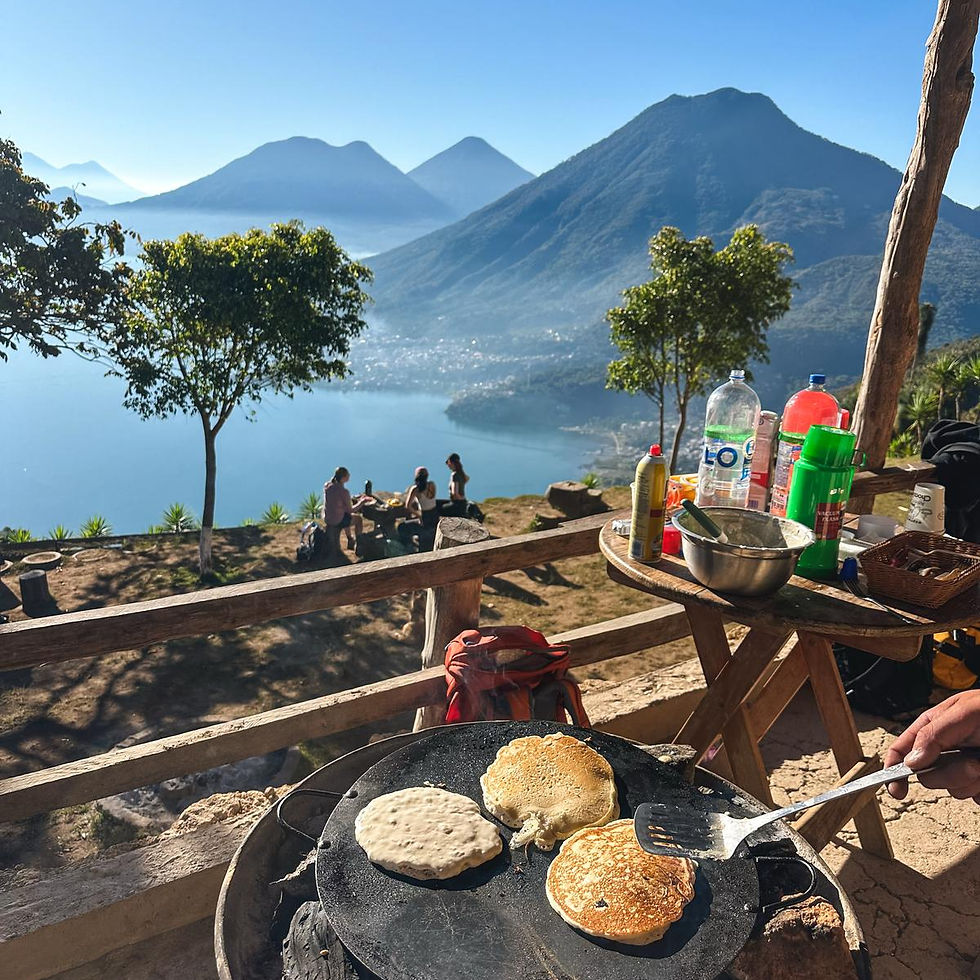
It happens more often than you might expect.
The lake has a community-minded feeling that is difficult to explain until you experience it. Each town has its own personality, and there is an almost ridiculous amount to see and do. You can hike volcanoes, swim in the lake, take boats between villages, learn Spanish, visit families, cook, make chocolate, weave, explore markets, go kayaking, work with local artisans, play soccer with neighborhood kids or simply sit on a dock and watch the clouds move across the volcanoes.
Our advice is usually to choose one town as your base rather than trying to move your family to a different hotel every night.
From there, you can take day trips or overnight trips to other towns around the lake.
You will probably see more, and you will certainly have a better chance of actually meeting people.

Calle de las Sombrillas | Umbrella Street, San Juan La Laguna, just around the corner from the Culture Chalk Accommodations!
A few common-sense rules
The same common sense that applies when traveling anywhere applies in Guatemala, but there are a few things we are particularly deliberate about with our children and guests.
Don’t go looking for trouble.
Don’t wander into neighborhoods you have no reason to be in simply because you saw something interesting on Google Maps.
Don’t flash expensive phones, cameras or jewelry around unnecessarily. We have never been robbed or mugged and have certainly seen our share of tourists ignoring this obvious rule, however, you will be looked at differently and you will almost certainly be charged more for things if you look mint. Dress modestly.
Don’t walk around unfamiliar areas late at night.
Use transportation arranged through your hotel, a trusted driver or a reputable service rather than climbing into an unknown vehicle because someone offered you a ride.
Don’t go to bars looking for trouble, and avoid getting involved with people who are visibly drunk or behaving unpredictably.
And, absolutely, do not go looking for weed or drugs in Guatemala.
You are not going to improve your vacation by trying to find the local drug scene. You are much more likely to create a problem that you did not need to have in the first place.

The goal is not to travel through Guatemala afraid of everything. For real, Guatemala is gorgeous, but the people here are even more beautiful than the landscape.
The goal is to know where you are, pay attention to your surroundings, use good transportation, listen to local advice and recognize that you are a visitor in someone else’s country.
So, is Guatemala safe for families?
We wouldn’t tell you that Guatemala is perfectly safe. That would be dishonest, and it wouldn’t be particularly helpful.
There are areas we avoid. There are situations we don’t put our children into. We pay attention to where we are going and how we are getting there. We use trusted drivers. We don’t treat a crosswalk like an invisible force field. And we teach our children to pay attention to the world around them.

But after years of living here with five children, Guatemala has proven to be an extraordinarily comfortable place for our family.
In fact, safety is only part of the reason we stayed.
We stayed because our children can walk into a community and know people. They can get on a boat and visit a friend. They can buy something at a little tienda and have a conversation with the person behind the counter. They can play soccer with kids who don’t speak English. They learned Spanish because there is every reason to speak it. They can see how people live when the answer to a problem isn’t always to buy something, drive somewhere or call someone else to fix it.
That kind of freedom comes with responsibility.
And that, in many ways, is exactly what we wanted for our children.
Guatemala has taught our family to pay attention, to ask questions, to trust people without being naïve, and to understand that safety is not the same thing as eliminating every possible risk.

For families willing to travel with a little common sense, a little humility, and a willingness to step outside the predictable, we think Guatemala can be an extraordinary place to bring your children.
If you are considering coming, start with our Guatemala Guide, and if you still have questions about what traveling here with your family actually looks like, send us a message. We live here. We travel here with our children. We're happy to tell you what we'd do if our family were coming for the first time.
DID YOU FIND THIS HELPFUL? PLEASE COMMENT BELOW AND SHARE ON YOUR FAVOURITE WORLDSCHOOLING PAGES!
Written by Owen D.: Proud father of five, living with my lovely wife Christina on Lake Atitlán and hosting beautiful community-driven hubs and adventures.


Thanks very much for these guidelines as helpful to 70 year-olds and seven year-olds, Owen. It all rings true to my limited experience in Guatemala City, Antigua and San Pedro La Laguna. We're looking forward to February at Culture Chalk.